


Flexible Automation for HVAC Equipment Manufacturing
HVAC equipment manufacturing often combines large panels, casings, access doors, ventilation parts, ductwork-related components, brackets, supports and structural elements within the same production environment. This creates pressure on setup discipline, bending capacity, material handling, WIP control and downstream assembly consistency.
For manufacturers of AHUs, RTUs, ventilation units and related HVAC structures, the challenge is not only to increase capacity. It is to manage high product mix, variable order patterns and finish-sensitive parts with a production flow that remains stable, traceable and repeatable.
Salvagnini supports HVAC manufacturers both in specific sheet metal operations and in more connected production flows. High-end machinery such as panel benders can help improve precision, repeatability and processing time for casings, panels, doors and similar components. Where the production model requires it, Salvagnini technologies can also be connected with storage, handling, punching-shearing, cutting and bending to reduce unnecessary transfers and improve flow from flat sheet to formed component.
- Produce panels, casings, ventilation parts and structural components with greater flow control
- Reduce setup losses, manual transfers and WIP between operations
- Support high-mix HVAC production with stand-alone machines or connected automation paths
Who this page is for
This page is intended for decision-makers in HVAC equipment manufacturing, including operations managers focused on throughput and internal flow, technical managers responsible for consistency and assembly fit, production planners managing large SKU counts and variable order patterns, and business owners looking to increase output without adding structural complexity to the factory.
Applications, products, and typical components
HVAC sheet metal production extends well beyond simple cabinet work. The manufacturing reality includes AHU and RTU panels and casings, access doors, wrappers, louvers, perforated air-path parts, ductwork-related components, brackets, supports, bases and enclosures. These parts differ widely in size, geometry, finish sensitivity and processing demands.
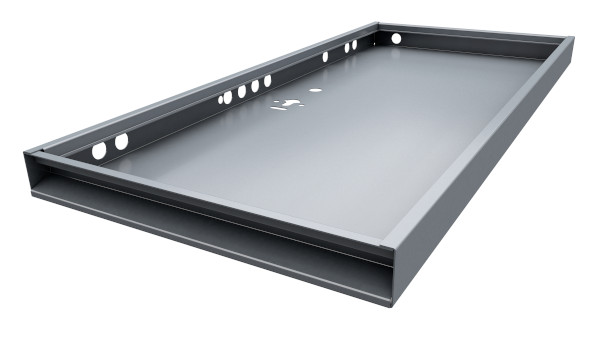
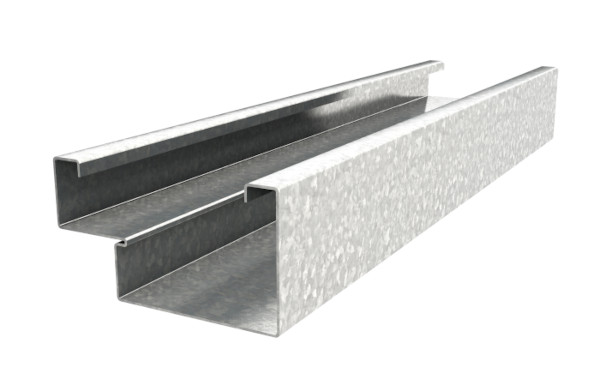
Salvagnini relevance in this sector is strongest where manufacturers need to manage panelized equipment, variable part families, high product mix, and more controlled internal flow.
- AHU and RTU panels and casings: insulated constructions, repeatable geometry, finish protection
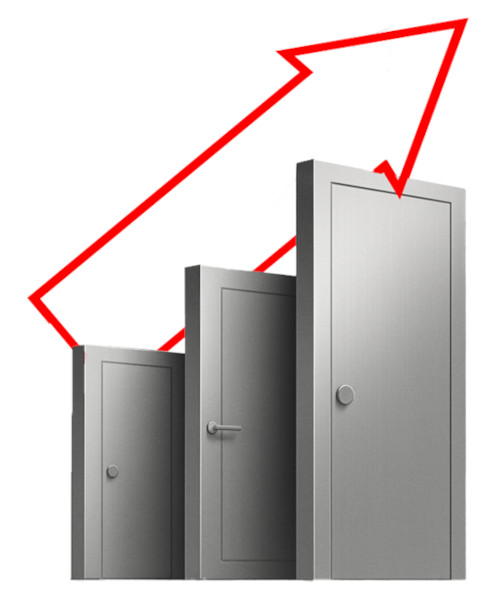
- Access doors and service panels: dimensional consistency, hardware interfaces, assembly fit
- Commercial and industrial HVAC structures: mixed sheet metal flows with variable part families
- Ventilation components and ductwork-related parts: speed, precision, and mix management
- Bases, brackets, supports, covers, and enclosures: long-tail SKU complexity and internal flow pressure
Your main manufacturing challenges
HVAC manufacturers may serve different product niches, but many sheet metal departments face the same production pressures: frequent changeovers, large panel handling, feature-dense parts, finish-sensitive materials and disconnected process islands.
- High product mix and frequent changeovers
High SKU counts, short runs and frequent program or material changes can turn productive time into setup time. For manufacturers handling many component families, setup discipline becomes a strategic issue, not only a local efficiency problem. - Bending pressure on large or awkward panels
Large casing panels, doors and wrappers often require handling, positioning and repeatability that are difficult to sustain manually. Where cutting capacity is already sufficient, the bottleneck may shift to bending. - Hole- and feature-dense parts
Louvers, air-path components, punched nozzles and similar geometries can increase tooling demand, programming effort, sorting complexity and dependence on secondary operations. - Finish-sensitive materials
Pre-painted and surface-sensitive materials make handling discipline critical. Scratches, marks and coating damage can generate rework, waste and downstream quality problems. - Fragmented production architectures
When storage, punching, cutting, buffering, bending and handling are managed as separate islands, WIP, waiting time and manual intervention tend to increase between operations. - Quality pressure from fit, sealing, and repeatability
For cabinet-based HVAC products, panel precision and construction consistency affect fit, sealing interfaces and repeatable assembly conditions across doors, casings and related structures.
The real question is not whether to automate every process at once.
It is which constraint should be addressed first, how connected the process needs to become, and which production path fits the plant’s actual mix.
Choose the production path that fits your plant
An AHU line with panelized casings, a mixed HVAC component shop and a bending-constrained plant do not require the same automation starting point. Salvagnini configurations should therefore be evaluated around the current production constraint: panel and casing flow, mixed-part flow or bending capacity.
The objective is to identify where the factory is generating the most WIP, handling, waiting time or repeatability risk, then define whether the first step should be storage, punching-shearing, cutting, bending, or a more connected line.
If your priority is panel and casing flow
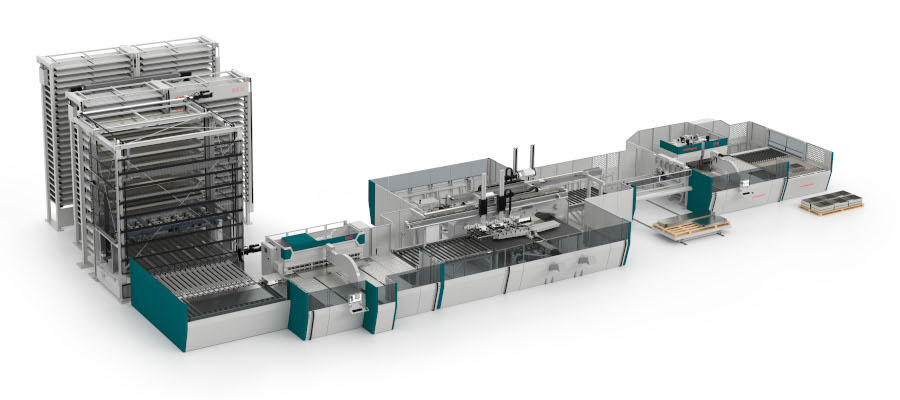
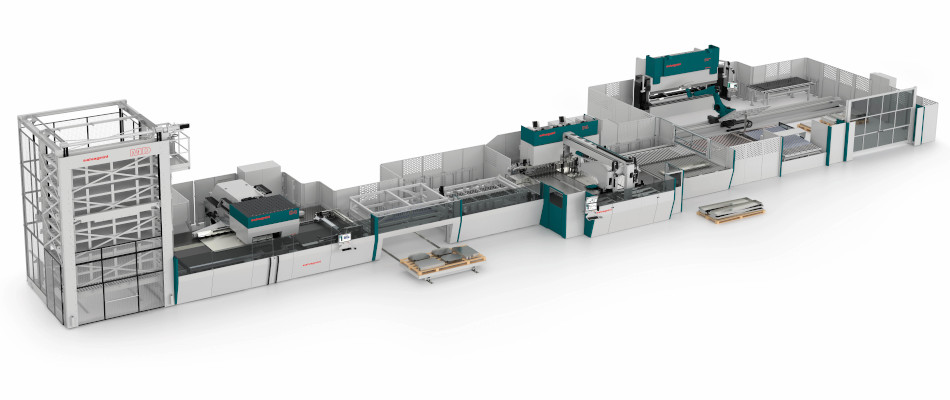
This path is relevant for manufacturers focused on AHUs, RTUs and other cabinet-based HVAC equipment, where panels, casings, access doors and related parts drive much of the production rhythm. In this context, an S4+P4 line, supported where appropriate by automatic storage, can connect punching-shearing and panel bending in a single flow. For HVAC panel and casing production, this can help reduce manual transfers, protect material quality and make large-part production more stable under variable mix.
What this path typically helps improve:
- panel throughput under variable mix
- repeatability on casing, door and wrapper components
- manual handling between sheet metal processes
- WIP generated by disconnected panel production steps
If you need a more integrated high-mix sheet metal flow
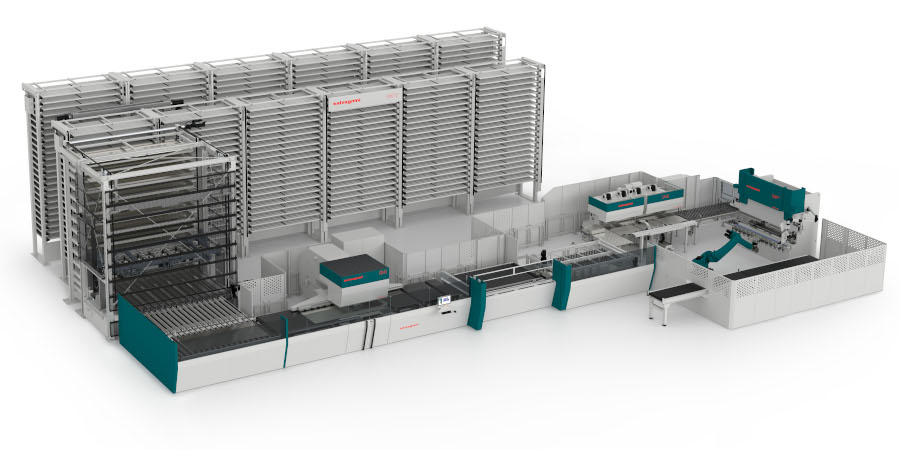
This path is relevant when the main issue is not one component family, but the interaction between many different parts moving through the same production environment. HVAC production often combines panels, ductwork-related parts, perforated components, brackets, supports and accessory parts. This increases pressure on programming, order release, sorting and internal logistics. In selected configurations, Flexible Smart Job Shop (FSJ) connects stand-alone technologies so they can work individually or together around converging production jobs. This approach can support storage, cutting, separation, bending, panel bending, software coordination and controlled material movement, depending on the configuration. Salvagnini’s STREAM and OPS software environments support programming and production data exchange within this broader logic.
What this path typically helps improve:
- setup-related productivity losses
- internal handling between cutting, punching and bending
- flow control across mixed component families
- planning discipline and production visibility
If frame bending is your main bottleneck
This path is relevant when large, awkward or variable parts concentrate labor, waiting time and repeatability risk at the bending stage. For panelized HVAC components, Salvagnini panel benders can support more stable output and reduce dependence on manual bending, especially where repeatability, part handling and downstream assembly consistency are critical. Where production includes variable geometries, narrow profiles or mixed downstream requirements, press brakes may remain part of the solution set. The priority is not to replace every bending method, but to decide which parts should move to panel bending, which should remain on press brakes, and how the two resources should work together in the production flow.
What this path typically helps improve:
- bending output stability
- repeatability on large or variable parts
- labor intensity in bottleneck operations
- predictability in downstream assembly flow
Phased automation instead of forced transformation
Not every HVAC plant needs to move directly to a fully integrated flexible manufacturing system. In many cases, the more realistic path is to start from the process that creates the most friction today, then progressively connect storage, handling, software and adjacent technologies as the production model evolves. A phased roadmap can begin with a local bottleneck, such as bending large panels or reducing manual transfers. It can then expand toward more connected material flow, better production visibility and stronger coordination between office programming and shop-floor execution.
Why this approach is relevant in door and frame manufacturing
Flexible automation is relevant in HVAC manufacturing when product variety increases but the factory still needs controlled flow through shared resources. Panels, doors, brackets, supports, ventilation parts and ductwork-related components may follow different process routes, but they often compete for the same programming, handling, bending and assembly capacity.
A more connected sheet metal flow can help reduce low-value manual transfers, improve control of WIP and make production conditions more repeatable. This is especially important where short runs, variable part families and finish-sensitive materials create operational friction between processes.
For management teams, the value is not only in a single machine. It is in the ability to build a scalable production path: solve the current bottleneck, protect part quality, improve flow visibility and leave room for future integration where it is justified by the plant’s mix and volumes.
Economic rationale: where automation can affect cost drivers
For HVAC manufacturers, the investment case should not be reduced to a generic productivity claim. The financial logic depends on where cost and risk are being generated in the current production flow.
The most relevant cost drivers usually include manual handling, repeated setups, WIP between operations, finish-related rework, bottleneck labor, underused downstream capacity and production delays caused by disconnected processes.
A phased Salvagnini roadmap can help evaluate these cost drivers one by one. A plant may start by stabilizing bending, improving panel and casing flow, or connecting storage and software to reduce waiting time and manual intervention. This supports a more controlled investment path instead of forcing an all-or-nothing transformation.
The right evaluation should compare the current production model with the expected future flow: which operations create waiting time, which part families generate rework, where skilled labor is absorbed by low-value handling, and which bottleneck limits reliable output.
Proof from the field
HVAC manufacturers do not all follow the same automation path. Some start from a specific bending requirement. Others build a connected flow around punching-shearing, panel bending, press brakes, storage, software and downstream operations. These examples show how different HVAC companies have used Salvagnini technologies to address product mix, internal logistics, bending capacity and production control.
Pro-Klima | Croatia
Integrated flow for customized air handling units

Pro-Klima, a Croatian HVAC manufacturer, produces highly customized air handling units for international markets. Before investing in Salvagnini, production relied on stand-alone cutting, punching and bending machines, creating segmented workflows and high material-handling costs.
The company introduced an S4+P4 production line together with a B3 press brake, later adding another B3 and the Salvagnini STREAM software suite. Pro-Klima reports productivity gains above its initial target, lower production costs, faster production, improved material flow and more accurate logistics. The company also identifies OPS and a possible new production line as future steps.
This example shows how connected automation can help customized AHU manufacturers move from segmented operations to a more ordered and controlled production flow.
Roccheggiani | Italy
Progressive automation for HVAC components

Roccheggiani manufactures ducts, components for air distribution plants, flues, heat recovery systems, terminal units and complete air-handling plants. Its automation path developed progressively, from individual machines to a highly automated system including three S4+P4 punching and panel bending lines, an MV store-tower, an L3 laser and two robotized bending cells.
The current system works over three shifts and is managed by 5–6 people across programming and production. Roccheggiani also reports reduced downtime linked to tool changes or item turnover, and better management of production peaks and changeovers.
This example shows how HVAC manufacturers can phase automation over time, moving from individual technologies to a broader digital and integrated production architecture.
Komfovent | Lithuania
Controlled logistics for AHU production

Amalva, the Lithuanian manufacturer behind the Komfovent brand, produces air handling units, ducts, fittings and other ventilation products. Its AHU range includes more than 200 standard casings, with flexible project solutions where each unit can be produced individually.
Before installing Salvagnini, the company identified flexibility and internal logistics as key constraints, with many forklift movements between operations. With the MV store and FMS line, Amalva reduced part movement, supported order-driven AHU production, increased capacity and expanded the range of products and layouts it could manufacture.
This example shows how storage and connected FMS logic can support wider product ranges, reduce internal movements and make order-driven AHU production more manageable.
Aspir Mecc | Italy
Stand-alone bending for custom HVAC

Aspir Mecc designs and manufactures customized air extraction and treatment systems, often producing panels in kits and batch-one conditions. To manage high item turnover and frequent tooling needs, the company selected a Salvagnini B3 press brake with FACE HMI, OPS and STREAMFORMER programming.
The case is relevant for manufacturers that are not ready for a fully integrated line but need to strengthen a specific operation. Office programming with STREAMFORMER helps define bending sequences and tool setup before parts reach the shop floor, supporting less experienced operators and reducing avoidable setup uncertainty.
This example shows that Salvagnini relevance in HVAC is not limited to complete lines: a single high-end bending technology can also be a credible entry point for customized, small-batch production.
Up to +35% productivity
Up to -10% production costs
More flexible production with less manual handling
Up to +45% added value per employee
Figures and statements are drawn from selected HVAC customer case studies and depend on product mix, configuration and production organization.
Related solutions, software, and services
Technologies
- S4+P4 flexible manufacturing systems for integrated punching-shearing and panel bending flows
- Panel benders for repeatable bending of panelized HVAC components
- B3 press brakes for variable geometries, profiles and parts that require conventional bending flexibility
- Flexible Smart Job Shop (FSJ) for connected production logic across stand-alone technologies
- Storage systems such as MD, MV and SMD to support material availability, buffering and reduced manual transfers
Services
- Production-flow studies and feasibility analysis
- Part-family and process evaluation
- Support during ramp-up and operator training
- Maintenance planning and service support
- Upgrade or expansion evaluation where the automation roadmap develops over time
Frequently asked questions
Yes, where the production flow is designed around the real part mix. Many HVAC plants need to manage large casing parts together with brackets, supports, perforated parts, enclosures and accessory components. The right configuration depends on volumes, geometries, material sensitivity and the current bottleneck.
Not only. Panels and casings are central in many HVAC products, but the manufacturing reality also includes wrappers, louvers, perforated air-path parts, ductwork-related components, access doors, supports and structural parts. This is why the production flow should be evaluated across part families, not only around one component type.
Then bending should be one of the first areas to evaluate. In plants where large or awkward panels depend heavily on manual handling, the constraint may concentrate at the bending stage even if cutting capacity is sufficient. The evaluation should identify which parts are suitable for panel bending, which should remain on press brakes and how both resources affect downstream assembly.
No. A phased roadmap is often the more realistic decision. Many plants can start from the most visible bottleneck, then progressively connect storage, handling, software and adjacent processes as needs evolve.
They can help simplify programming, support production data exchange and reduce manual interruptions between operations. Their relevance is strongest where product mix, order variability and internal logistics already create operational friction.
A practical starting point is the setup-to-run ratio, WIP between operations, bending bottleneck intensity, internal handling effort, finish-related rework, lead-time by part family and output stability across variable mix.
The financial case should be based on the plant’s actual cost drivers: labor absorbed by handling, setup frequency, rework, WIP, bottleneck delays, underused downstream resources and the scalability of the investment. Quantified ROI or payback should only be used when validated data is available.
This should be addressed during configuration, feasibility review and ramp-up planning. Training, service support, maintenance planning and software adoption are part of the evaluation, especially when the roadmap includes storage, connected flow or multiple technologies.
Whether your priority is panel and casing flow, a more integrated high-mix sheet metal process, or relief of a bending bottleneck, the first step is to understand where complexity is being created in your current production flow.
A focused review of your part families, volumes, process layout and bottlenecks can help define which intervention should come first, and which steps can be phased in later.