


Flexible Automation for Door and Frame Manufacturing
The door and frame market is growing more complex. Stricter regulations, higher expectations for performance and design, and the spread of smart building technologies are driving more variants, shorter runs, and tighter delivery commitments. For many manufacturers, the challenge is no longer demand alone, but the ability to manage this complexity profitably, with consistent quality and reliable lead-times.
Salvagnini supports door and frame manufacturers by analysing the sheet-metal flow behind doors, frames and kits, then identifying where cutting, punching, bending, automation and software can reduce avoidable handling, setup losses and process fragmentation. The objective is not simply to automate individual machines, but to build production flows that help improve throughput, quality and OEE while keeping TCO under control.
- Produce doors, frames, or integrated kits with greater control
- Reduce WIP, setup losses, and operator dependency
- Support certified, customized, and short-run production
Who this page is for
This page is intended for decision-makers in door and frame manufacturing, including operations managers focused on throughput and OEE, technical directors responsible for certified products and process stability, production planners managing high product mix and short lead-times, and business owners looking to increase output without increasing structural complexity.
Applications, products, and typical components
Salvagnini solutions are used across a wide range of door and frame applications, including security and armoured entrance doors, residential and architectural doors, internal steel doors, and certified fire doors. Typical components include door leaves and covers, frames and jambs, transoms and side panels, reinforcement profiles, thresholds, and other structural or aesthetic sheet metal parts.
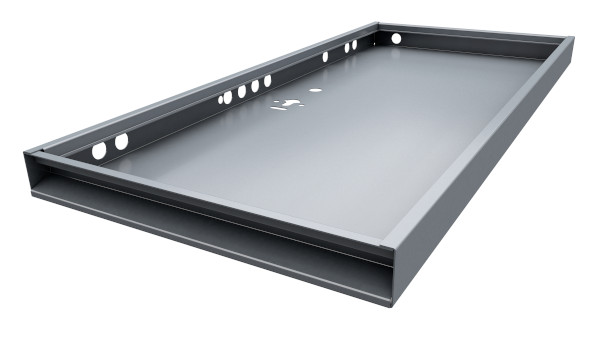
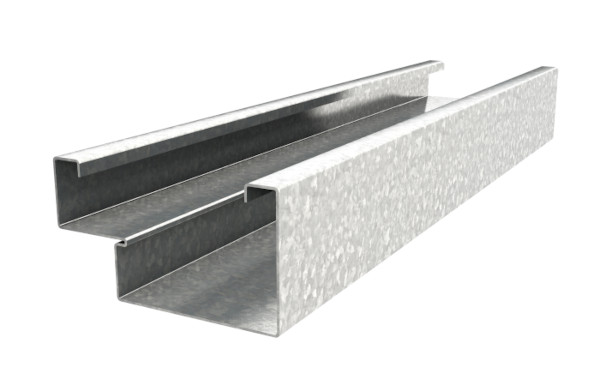

For product design and R&D teams, feasibility analysis can identify where features such as stiffeners, fixing points, kerfs and rebates can be integrated into the sheet, and where part count or welding operations may be reduced. These opportunities depend on material, geometry, certification requirements, finish quality and downstream assembly constraints. When the application is suitable, this can support faster industrialization of new door families and greater differentiation in design-driven segments.
- Security and armoured doors: complex geometries, certified performance, repeatable quality
- Residential and architectural doors: design freedom, finish quality, broader product variation
- Internal steel doors: stable, efficient production for standard and configured models
- Certified fire doors: traceability, dimensional consistency, reliable process control
- Frames and jambs: profile complexity, kit logic, and bending productivity
- Transoms, side panels, and accessories: integrated production of complementary components

Your main manufacturing challenges
Door and frame manufacturers across markets face similar structural pressures. The context may vary, but the underlying manufacturing challenges are often the same.
- High product mix and small batches
Small batches should not mean small margins. Customized dimensions, optional features, and certified fire or security performance can quickly translate into very short runs, frequent setups, and a growing number of production SKUs. - Throughput below nominal capacity
Changeover time should not replace production time. Machines often spend too much time in preparation instead of productive cutting, punching, or bending, keeping OEE below potential. - Dependence on scarce skilled labor
Performance should not depend on a few individuals. The shortage of experienced operators can make quality and repeatability too dependent on a limited number of people, making output harder to scale without compromising standards. - Rigid, fragmented production architectures
Traditional process chains organized as stand-alone islands lose time in manual handling and changeovers, while dedicated high-productivity lines may struggle with short runs, made-to-measure doors, and kit-based deliveries. - Separate flows for doors and frames
Doors and frames are often produced on different lines, with separate stocks and planning rules. The result is duplicated WIP, longer lead-times, and hidden complexity in planning and logistics.
The real question is not whether to automate.
It is where automation should start, how integrated it should become, and which bottleneck should be addressed first.
Choose the production path that fits your plant
Door and frame manufacturers do not all start from the same situation. Some plants need to stabilize certified fire or security doors. Others need to remove bottlenecks in frame production. Others want to move from separate flows to true kit production. For this reason, Salvagnini offers a spectrum of flexible automation configurations built on the same logic, but aligned with different priorities.
Each path should be treated as an evaluation route, not a fixed recommendation. The right starting point depends on product mix, door/frame ratio, frame-profile complexity, current bottleneck, available space, software readiness and the level of integration the plant can absorb. The priority is to translate current factory stress into a clear roadmap, then evaluate which step can deliver measurable improvements in throughput, OEE, lead-times and quality.
If your priority is door leaf production
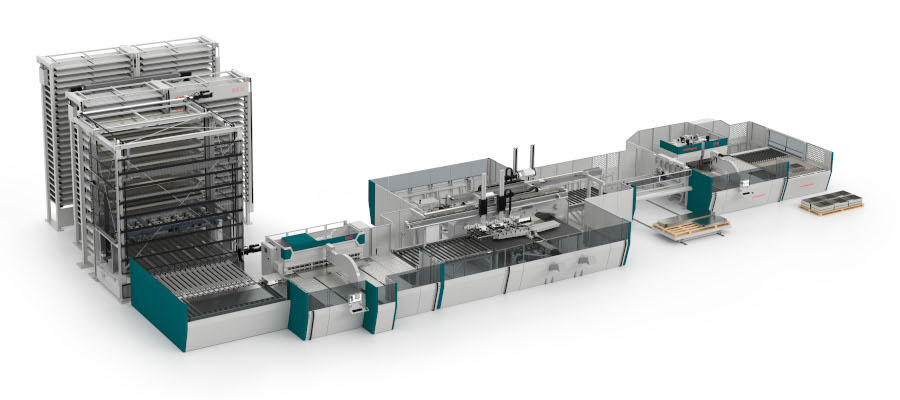
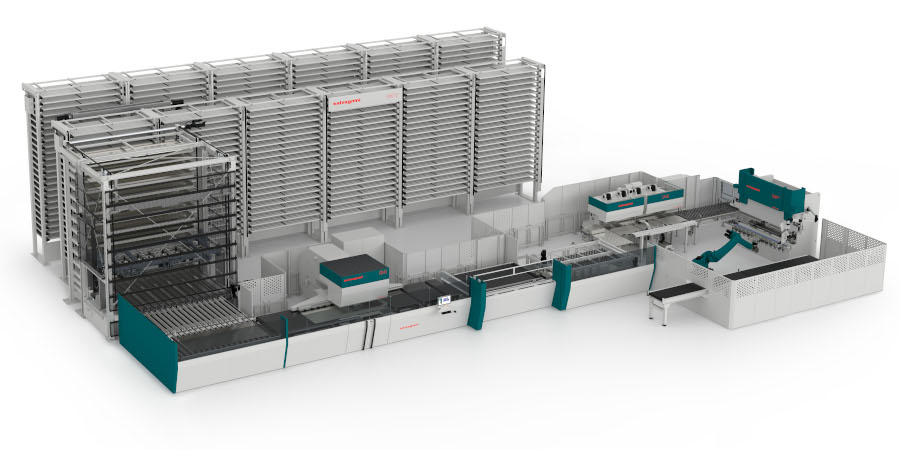
For manufacturers focused primarily on the door leaf, flexible manufacturing systems for doors connect sheet loading, cutting or punching, integrated panel bending, and automation into one coherent production line. The goal is to maximize throughput and flexibility for door production while ensuring geometrical stability and traceability for certified models.
What this path typically helps improve:
- door throughput under variable mix
- quality repeatability across certified models
- setup-related productivity losses
- dependence on manual handling between operations
If you need integrated door + frame kits
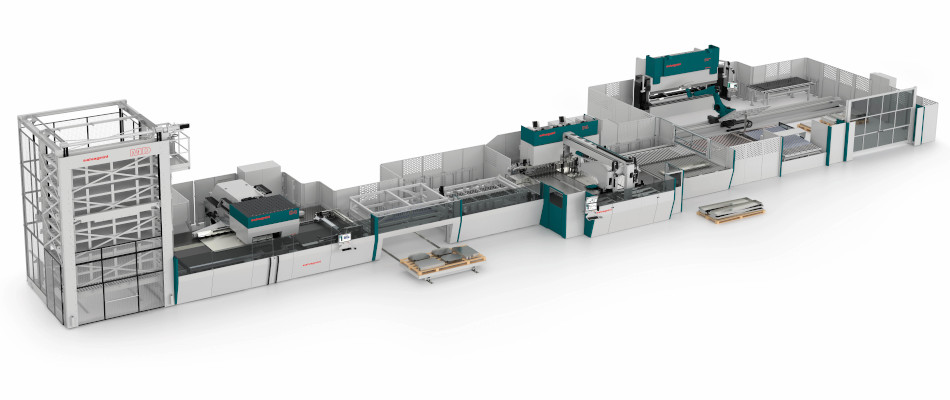
For companies that want to overcome the separate-flows issue, systems for doors and frames can manage both within a more coordinated production logic. The aim is to produce kits — door and frame together — reducing WIP, simplifying planning, and aligning production more closely with assembly and shipping sequences. This helps factories move from disconnected islands of automation to a more integrated production flow, better aligned with how products are delivered and installed on site.
What this path typically helps improve:
- kit completeness and sequencing
- planning efficiency across product families
- WIP generated by disconnected departments
- lead-time predictability from order to shipment
If frame bending is your bottleneck
When frame production is the main bottleneck, the FB frame bender combines a panel bender with a robotic press brake in an automated approach to profile manufacturing. Instead of splitting work between separate bending stations, the system manages both within a single concept: the more complex side of the profile, for example the gasket seat, is bent on the panel bender, while the simpler bends are handled on the press brake. This makes it possible to cover a wide range of frame profiles with stable quality and predictable output. For capacity modelling, productivity figures should always be read together with the applicable profile complexity, shift length, OEE basis and system configuration. Once these conditions are confirmed, the FB frame bender route can give a concrete basis for evaluating capacity, labor use and investment priority in the frame department.
What this path typically helps improve:
- frame output stability
- bending consistency across profile variants
- use of labor in frame departments
- capacity modelling for automation investments

Phased automation instead of forced transformation
Not every plant is ready to move directly to a fully integrated flexible manufacturing system. In many cases, the most effective path is to start with stand-alone systems and then progressively connect them with storage, handling, and software as the automation roadmap develops.
Why this approach is relevant in door and frame manufacturing
Flexible automation matters in this sector because it helps manufacturers manage variability without forcing production into rigid, over-specialized flows. It can stabilize quality for certified products, reduce manual dependence in high-mix environments, and support more efficient production of both standard and made-to-measure models. This is especially relevant where product variety, labor shortage, and delivery pressure all exist at the same time.
Integrated process control also improves traceability and visibility from order intake through the finished product, helping manufacturers manage complexity with more discipline and less hidden waste.
Proof from the field
Door and frame manufacturers do not all follow the same automation path. Some need to increase security-door throughput. Others focus on frame production, material flow, kit logic, or the ability to manage high product variety without increasing handling and WIP. These examples show how different door manufacturers have used Salvagnini technologies to address product variability, in-house component production, integrated punching-shearing and panel bending, storage, bending capacity and production control.
Hörmann Changshu | China
Batch-one flexibility with S4+P4 line

Hörmann Group, a family-owned door manufacturer founded in 1935, operates more than 40 factories worldwide. In China, the group opened sites in Beijing, Tianjin and Changshu, with the Changshu factory established in 2018 after strong order growth created capacity pressure.
For the new Changshu site, Hörmann selected a Salvagnini line with storage, S4 punching-shearing and P4 panel bending. The goal was to support the Chinese market’s demand for high product variety, individual project requirements and fast product renewal with a flexible, automated one-piece-flow production model.
Hörmann also highlights the value of local service, maintenance support and the wider Salvagnini network in China. This example shows how integrated automation can help door manufacturers combine flexibility, capacity and service confidence when building or upgrading production for fast-moving markets.
Gardesa | Italy
Security doors in flow

Gardesa, an Italian security door manufacturer based in Cortemaggiore, has been active for more than 40 years and has sold over two million units. Under the Bertolotto group, the company invested in R&D, internal logistics and more controlled in-house component production.
The company’s Salvagnini department produces door leaves, finishes, trims, jambs and frames using two S4+P4 lines and two B3 press brakes. The latest S4+P4 line is fed by two MD single-sheet store-towers and supports variable, parameterizable security-door production.
Gardesa reports higher production speed, improved material efficiency through optimized nesting and reduced scrap, and better material control thanks to the dual vertical store-tower. This example shows how integrated punching-shearing, panel bending, storage and press-brake capacity can help security door manufacturers manage variability with a more ordered production flow.
Up to 66% cycle-time reduction in a comparable industrial context
Up to 140 kits/shift for complex frame profiles
Up to 350 kits/shift for simpler frame profiles
Figures and statements are drawn from selected doors&frames customer case studies and depend on product mix, configuration and production organization.
Related solutions, software, and services
Technologies
- Flexible manufacturing systems for integrated cutting, punching, bending and automation flows for door leaves, frames and kits
- Panel benders for repeatable bending of door panels, covers, jambs and other sheet-metal components
- FB frame bender for automated frame-profile production combining panel bending and robotic press-brake bending
- B3 press brakes for profiles, reinforcements and parts that require conventional bending flexibility
- Punching machines or 2D laser systems for prepared blanks, fixing features, holes and formed details
- Storage and handling systems to support material availability, buffering and reduced manual transfers where integration is required
Services
- Production-flow studies and feasibility analysis for doors, frames, profiles and kits
- Process evaluation based on current product mix, bottlenecks and layout constraints
- Support during ramp-up and operator training
- Maintenance planning and service support
- Upgrade or expansion evaluation where the automation roadmap develops over time
Frequently asked questions
Yes, when the product mix, part geometry and process flow are suitable. The objective is to manage variety, short runs and certified models with less disruption from setup, manual handling and disconnected production steps.
Yes, where the production logic and layout support it. A key objective is to reduce separate stocks, duplicated WIP, and planning friction by moving toward a more coordinated kit-based flow.
Then the best entry point may be the frame bottleneck itself. The FB frame bender route is designed for this case, combining a panel bender and a robotic press brake within one automated concept. The right configuration should be evaluated according to frame geometry, profile complexity, expected mix and required output.
Not necessarily. In many cases, a feasibility review can show whether specific features can be integrated into the sheet, whether welds or part counts can be reduced, and whether pre-coated materials can be managed effectively. The answer depends on geometry, material, certification constraints and the required finish.
No. A phased roadmap is often the better decision. Many plants can start with stand-alone systems and integrate storage, handling, and software later as needs evolve.
Start with the indicators that reveal where complexity is created: OEE by product family, setup-to-run ratio, WIP between operations, kit completeness, labor intensity per shift, lead-time by order type and rework rate on certified products.
Whether your priority is door throughput, integrated kit production, or frame bending capacity, the first step is to map where complexity is created in your current flow and identify which intervention can generate the clearest operational return.